360 product photography
How to set up a 360 product photography studio
Space, lights, turntable, camera, and frame count — whether you are starting on a desk or running a production floor. Then host the spins on a 360 product viewer and publish them to ecommerce.
360 Product Photography Guide walks through capture, editing, hosting, and publishing.
What a 360 studio actually is
A 360 product photography studio is a repeatable setup: a still camera, even lighting, a rotating platform, and a background that stays the same for every frame. You do not walk around the product. The product rotates; the camera stays locked.
This page is about building your own studio. SpinShot makes the turntable, riser, and lifter and the hosted 360 product viewer (zoom, mobile, ecommerce embeds, analytics, pricing, and a free trial). We also shoot in-house for clients who ask — that is not what this guide is for.
Space
You do not need a warehouse. You need a room you can control.
How much room
For products up to about loaf-of-bread size, a small office is enough. Leave room for two side lights, a background light, a tripod, and a turntable on a table or stand about waist height.
Kill other light
Turn off ceiling lights and close blinds. Mixed daylight and studio lights shift color as clouds move. 360 views need every frame to match.
Write the setup down
Record camera height, distance to the turntable, light distances, and power settings. That is how a catalog stays consistent from product to product.
Lighting
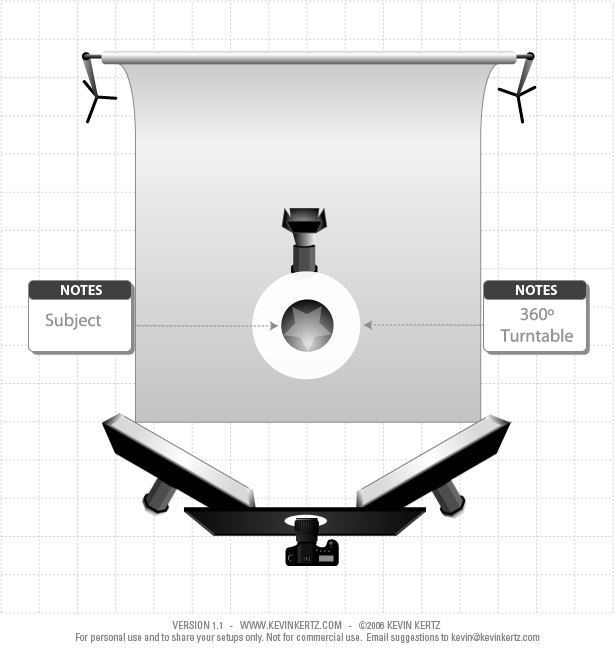
Two lights on the product (left and right of the camera) and one on the background is the standard starting point. Softboxes or diffusion keep specular highlights from crawling as the product rotates.
Strobes freeze motion and help with reflective goods. Continuous lights are cheaper and easier to learn. Either works if power and position stay fixed.
For a highly reflective product, a paper tube around the turntable (seamless “Savage” paper works) wraps light around the subject. Polarizing filters help on glossy helmets, watches, and chrome. See studio supplies and strobe notes.
Turntable: DIY vs production
Any rotating platform with a circular top can work. Even spacing is the requirement that matters.
DIY / manual
A lazy Susan or DIY motorized table is enough to learn. Mark 24 (or 16) even ticks around the rim so each frame is the same angle.
Find center with a dry-erase mark on plexiglass, or tape a square around the midpoint so products sit in the same place every time.
Production / motorized
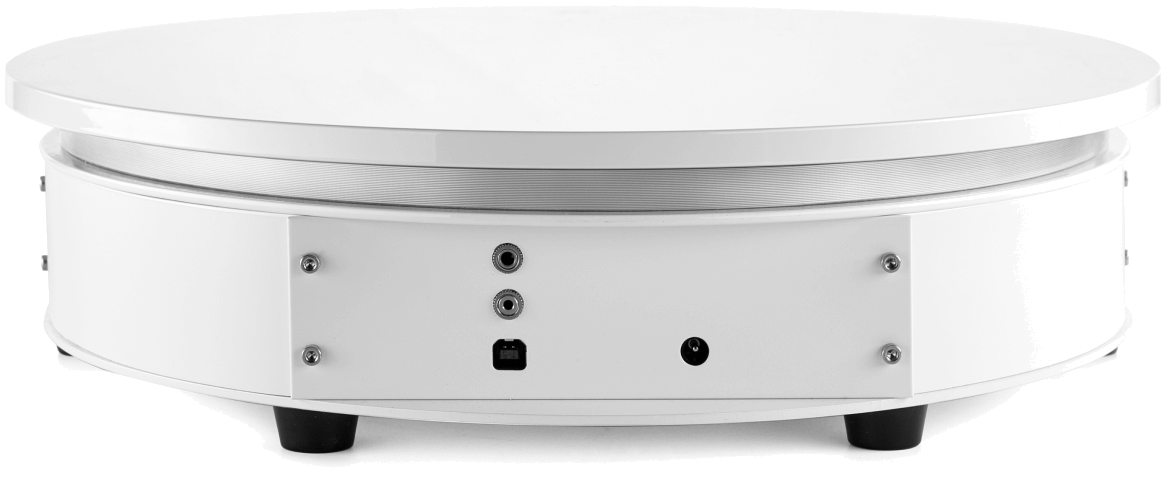
A SpinShot Turntable automates rotation so frame count and spacing stay consistent across a catalog. Pair with the Riser for shadowless white and the Lifter for small or off-center items.
Hardware should work with any camera and any hosted viewer. Do not pick a table that locks your files into one vendor.
Camera and tripod
Any camera with a real manual mode works — DSLR, mirrorless, or a capable compact. Lock shutter, aperture, ISO, and white balance. Turn off image stabilization / vibration reduction or the product will drift in the spin.
Typical starting point: ISO 100, f/8–f/16, shutter set so the background is just barely white. Fire with a wired remote so you never touch the camera. A sturdy tripod is non-negotiable.
How many images
24 frames is the usual balance of smoothness vs shoot and edit time. Use a multiple of 4 so you keep exact front, back, and side angles. 12–16 is fine for price-driven catalogs. Jewelry and other sparkle-heavy products may want 72–120.
Read the frame count and image dimensions guide. Rotate clockwise; skip shooting the start frame twice.
A production workflow that holds up
- Unpack and clean. Dust on one frame becomes a blinking speck on 24. Lint roller, air puffer, extra minutes here save hours in Photoshop.
- Studio prep. Turntable centered, lights on, camera locked, color chart in the first test shot.
- Shoot. Product facing camera on frame one (people often face away). Check the subject stays in frame through a full rotation. Center circular objects before you start the set.
- Batch-edit. Same crop, white balance, and background treatment on every frame. Batch editing and Photoshop actions.
- Host and publish. Upload to a hosted 360 product viewer. SpinShot stores frames on a CDN, serves zoom and mobile, and embeds on Shopify, WooCommerce, Magento, and custom sites. Analytics, pricing, and a free trial are part of that software — not extras you bolt on later.
FAQ
How much space do I need for a 360 product photography studio?
A small room or office is enough for products up to about loaf-of-bread size. Close blinds and turn off other lights so your studio lights stay consistent.
Do I need a motorized turntable?
No. A manual turntable with evenly spaced marks works for beginners. A motorized turntable like the SpinShot Turntable is worth it when you shoot many products or need consistent frame spacing.
How many photos should I shoot per 360 view?
24 frames is a common balance of smoothness and production time. Use a multiple of 4 so you keep exact front, side, and back angles. Jewelry and other detail-driven products may use 72 or more.
What happens after I shoot the photos?
Batch-edit the set, upload to a hosted 360 product viewer, and embed the spin on your product pages. SpinShot hosts frames on a CDN, supports zoom and mobile, and embeds on Shopify, WooCommerce, Magento, and custom sites. A free trial is available.
Next: shoot, then publish
Use the photography guide for the first capture. Use hardware when you are ready to automate. Use the viewer to host, zoom, and embed — including Shopify.